
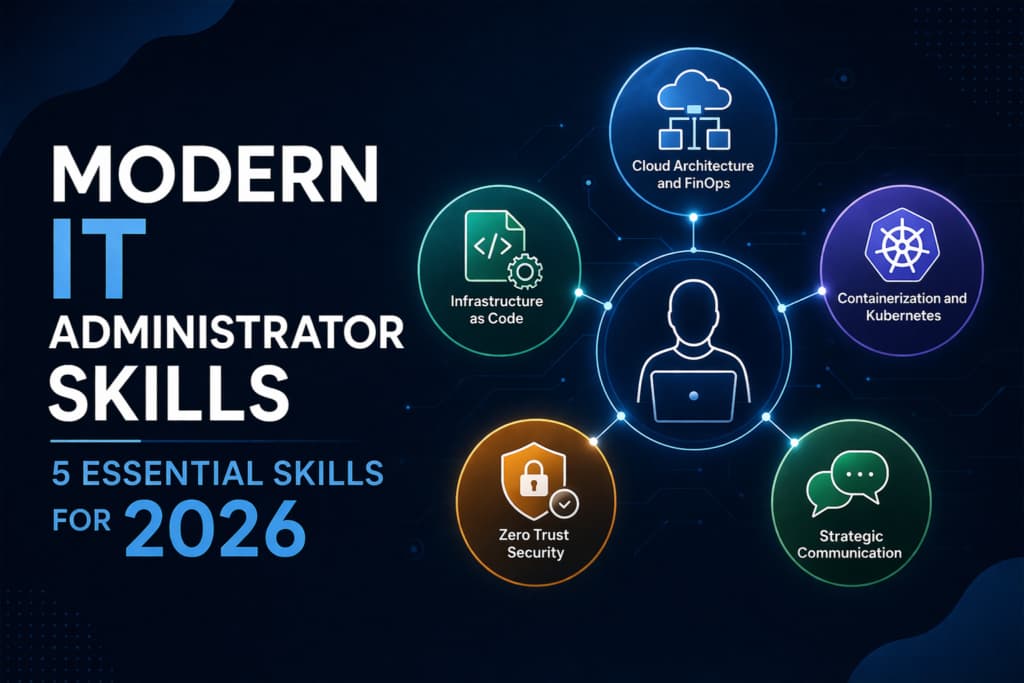
Modern IT administrator skills are evolving rapidly as cloud, automation, and security reshape the industry.
1. Cloud Architecture and FinOps
Knowing how to spin up instances in AWS or Azure is table stakes at this point. What actually moves the needle is FinOps: the discipline of balancing real performance needs against what the business can justify spending.
Here’s a scenario that plays out constantly. A company provisions high-powered compute resources for a peak traffic period, then forgets to scale back down. Weeks pass. The bill arrives. Nobody’s happy. A skilled admin builds auto-scaling policies that expand capacity on demand and quietly contract during off-hours, sometimes cutting monthly cloud costs by 40 to 50 percent.
That kind of result gets noticed in the boardroom faster than almost anything else you can do.
2. Infrastructure as Code
Clicking through a GUI to configure servers isn’t just slow, it’s a liability. Modern environments change too fast for manual setups, and human memory is a terrible disaster recovery plan.
Tools like Terraform and Ansible let you define your entire infrastructure in version-controlled code. When a critical system goes down at 2am, you don’t rebuild it from scratch by trying to remember every setting. You run the script. Same environment, same configuration, back online in minutes. In practice, this single shift eliminates an entire category of operational risk that manual processes can never fully solve.
If you’re new to Linux environments, understanding basic commands is essential:
https://thetechnicalstuff.com/top-120-linux-commands-for-linux-administrators/
3. Containerization and Kubernetes
Virtual machines aren’t going anywhere, but containers are what modern applications actually run on. Docker and Kubernetes have moved well past “developer territory.” For any admin managing production environments, these are core competencies now.
What makes this skill genuinely useful day-to-day is how it changes deployment. Rather than scheduling a midnight maintenance window to push an update, containers allow the system to replace components piece by piece while everything keeps running. Something breaks? The orchestrator rolls back automatically. Users notice nothing. Realistically, that’s the kind of seamless operation that used to require entire DevOps teams.
Before working with containers, it’s important to understand system navigation in Linux:
https://thetechnicalstuff.com/cd-command-linux/
4. Zero Trust Security
The comfortable idea of a “secure perimeter” around your internal network doesn’t hold up anymore. Hybrid work, cloud services, and increasingly sophisticated attacks have made it obsolete. Zero Trust is the replacement model, and its core premise is blunt: assume the breach has already happened.
Every access request gets verified individually, regardless of where it originates. An employee’s compromised credentials don’t hand an attacker the keys to everything, because access is segmented and continuously validated. Compare that to the old model, where one infected laptop could laterally move through an entire corporate network within hours. The difference in exposure is enormous.
5. Strategic Communication
Arguably the most underrated skill on this list has nothing to do with a terminal window. It’s the ability to translate technical problems into business consequences, and it’s something a lot of talented admins genuinely struggle with.
Telling leadership that your storage arrays are showing degraded IOPS doesn’t land. Telling them that the current disk latency is adding measurable delays to order processing, and that fixing it costs a fraction of what the slowdown is losing per week, that’s a conversation that gets budget approved. In my experience, admins who can make that translation consistently tend to have far more influence over infrastructure decisions than those who can’t.
Where Does This Leave You?
The modern IT administrator isn’t a break-fix technician with a better job title. The profession has genuinely shifted toward proactive architecture, automation, and business alignment. Master these five areas and you’re not just keeping pace with where the industry is going. You’re ahead of most of it.
Learn networking fundamentals:
https://thetechnicalstuff.com/osi-model-layers/